II.I.IX. Boswellia samhaensis Thulin & Scholte
Boswellia samhaensis is an endemic species of Samha Island belonging to the Socotra Archipelago. This species has been discovered by Paul Scholte, Ahmed Saed Suleyman, and Abdulraqeeb Al-Okaishi in 2006. It is a dwarf tree, up to 1.5 m. Leaves are imparipinnate, growing in shoot apices with 11-19 leaflets, 4-11 cm long. Reddish flowers are produced before or with leaves and grow in long, densely pubescent racemes. Fruits are 5 locular, narrowly winged.
Boswellia samhaensis is a very rare cliff-growing species found exclusively on top of large boulders together with Euphorbia arbuscula at an altitude of 58–353 m in Samha, a small island in the Socotra Archipelago. It is the only local endemic Boswellia of Samha, and it is not found in Socotra Island. The EOO is 4 (0,06) km2 and AOO is 4 km², corresponding to a single threat-defined location. Only one small area is known from Samha Island where we counted 244 individuals in four adjacent localities. These trees found on the top of inaccessible large limestone boulders; one boulder hosts ca. 172 trees, the other sites have less numerous stands. There may be more localities on Samha Island, however the terrain is highly inaccessible. We currently estimate the population at about 300 individuals, not accounting for those we are not able to see (and not known by local communities, who helped during the survey). This relict population is exclusively found in areas that are inaccessible to goats, so grazing has most likely driven all accessible local populations to extinction.
The species is sensitive to overgrazing and adult trees only occur currently in localities inaccessible to goat browsing. Young trees are absent in the surrounding area, as any goat browsing around these boulders has destroyed all individuals. This small remnant of B. samhaensis is sensitive to landslides and other manifestations of global climate changes (e.g., drought, heavy rains) in the single small area where it is found (one landslide tipping over the boulders can be enough). Illegal collection by succulent collectors should be monitored as well, as this species is also appearing on the market (personal observation), and the number of individuals in the wild is extremely low, so it is an actual direct threat. We did not assess individual tree health but due to the small population size within a small area, a single disease or insect pest could also destroy the entire species.
According to the IUCN Red List the species is assessed as Critically Endangered – CR B1ab(v)+2ab(v), C2a(ii).
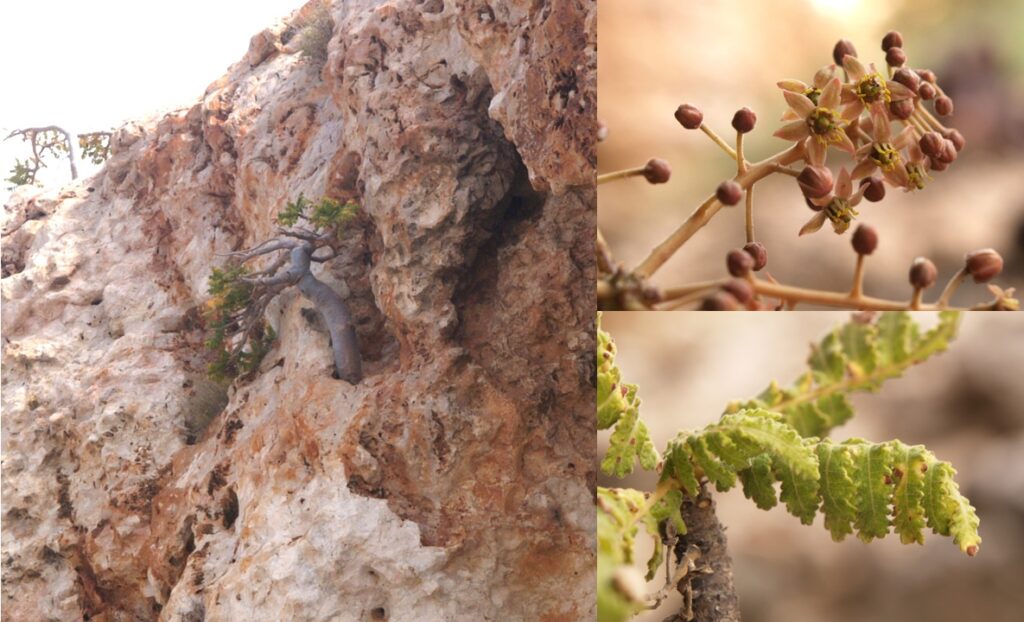
Figure. Boswellia samhaensis Thulin& Scholte
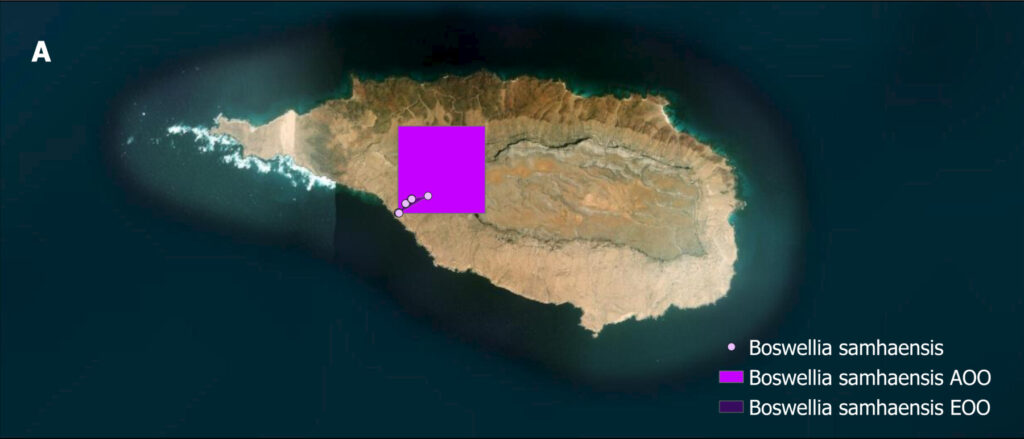
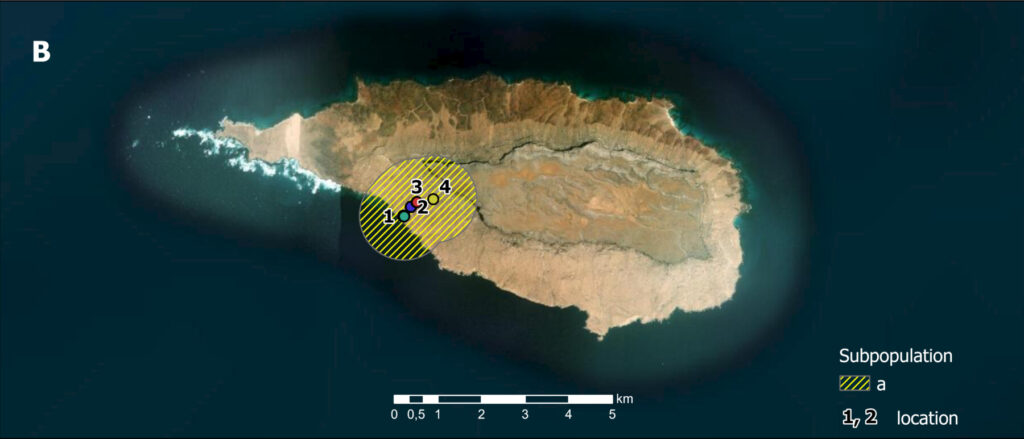
Figure. A: Recorded trees, AOO and EOO; B: subpopulations and localities of Boswellia samhaensis in Samha Island.