II.I.I. History and cultural importance
The word frankincense probably originates in French and means noble or true incense. The earliest description of use or trade comes from Ancient Egypt, where frankincense together with myrrh was used in funeral ceremonies. The dead king was perfumed with incense to be accepted by gods and affirmed as a god (Grieve and Leyel, 1973). A relief in the temple at Deir al-Bahari describes the story of Queen Hatshepsut in 1495 BC who sent an expedition to the Land of Punt to bring back the incense trees to be planted in the terraces of her palace. However, it remains unclear if the trees painted in the temple were myrrh or frankincense trees (Hepper, 1967).
The characteristic medicinal properties and divine smell of frankincense gave rise of the Incense route across Arabia, passing through Alexandria, where frankincense was processed and distributed to the Mediterranean region (Van Beek, 1960). The trade route was monopolised by the Arabian tribe Nabatheans which lasted for 500 years (300 BC to AD 200). At a peak of the demand, over 3,000 tons of incense was shipped annually to the Roman Empire mostly coming from southern Arabia through Mesopotamia (Coder, 2011). The sacred ceremonies with burning frankincense and myrrh to honor the gods became soon very popular. With an increase in demand for incense, it was transmuted into the luxury item which determines a social status of people. Nero was said to have burnt such a huge amount of frankincense at the funeral of his wife Poppaea, that it exhausted the supply of frankincense in Arabia for a whole year (Pliny the Elder).
The Bible mentions frankincense 22 times (Holy Bible, 2007) and the legend says that gold together with myrrh and frankincense were the gifts brought by three Magi to the newborn Jesus Christ. Frankincense and myrrh were so valuable, that they equalled to the value of gold. In the Quran, frankincense or luban (in Arabic) was recommended by prophets in a mix of spices for healing purposes (Eliyasee and Ali, 2005).
At the beginning of the 4th century, the demand for frankincense rapidly lowered. The reason for the collapse of the market was the conversion of the emperor and the rise of Christianity. The emperor Theodosius banned pagan practices including the use and burning of incense (Groom, 1981).
Frankincense has been widely used for generations not only for cultural and religious, but also for the medicinal purposes. In Ancient Egypt, frankincense was used to treat fever, colds, asthma, and other health problems (Al-Harrasi et al., 2019a). In the 10th century AD, frankincense was used by the famous Iranian physician Ibn Sina to treat fevers, vomiting, dysentery, and even tumors (Hussain et al., 2016). Chinese medicine used frankincense to treat bowel disease, chronic pain syndrome, gonorrhoea, leprosy, skin disease, sore throat, and urinary and gynaecological problems (Al-Harrasi et al., 2019b; Banno et al., 2006b). In India, frankincense was used for its rejuvenating effects (Van Vuuren et al., 2010).
Even today, frankincense is widely used as a homemade medicine. In Arab-African countries, water extract of frankincense is used as a treatment for cough, stomach, and liver problems. On Socotra Island, frankincense is burnt in houses to clean the house before giving birth to a child. Furthermore, burnt incense is believed to have a psychoactive effect on humans (Dannaway, 2010).
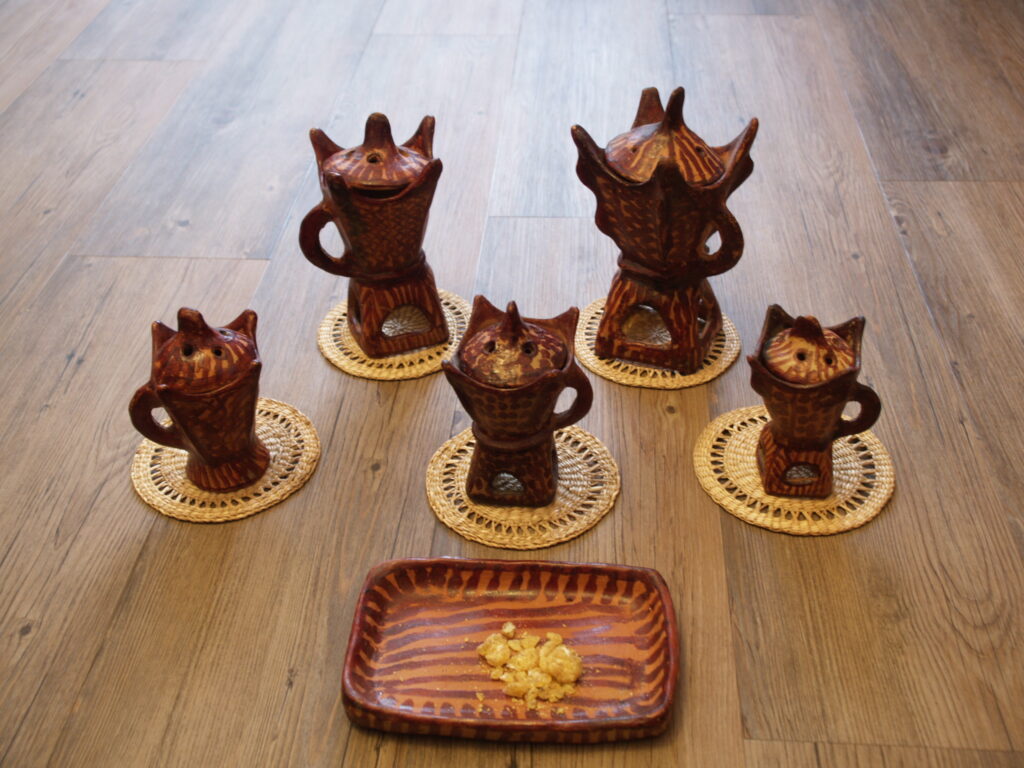
Figure. Traditional incense burners handmade in Socotra, dyed with dragon’s blood.