II.I.II. Boswellia ameero Balf. f.
Boswellia ameero is an endemic ground-rooting tree growing on Socotra Island. The tree has a flaky yellow to brown bark. Leaves are imparipinnate, pubescent with up to 17 leaflets, 14-25 cm long. The species can be easily recognized by pink flowers with seven petals.
Boswellia ameero is restricted to Socotra Island where it is locally common in dry, semi-deciduous forests and woodlands in highlands, hillsides of mountains and valley slopes on both limestone and granitic substrates. It is one of the ground-rooting species and occurs at an altitudinal range of 322–966 m asl, in fact it has the relatively highest median altitude compared to the others (above 700m). The total AOO is 132 km² and the EOO 485 km² (Fig. S2A). Distribution is strongly fragmented; within 11 localities we found 4 subpopulations, which occur in 5 threat-defined locations. Some localities consist of one to a few trees which can be considered as near extinct; these small subpopulations are not viable (no natural regeneration). The largest subpopulation is a dense forest around the Haggeher mountains (mainly in Daneghan and Ayheft valleys) in the central eastern part of Socotra Island, where we inventoried 3,044 mature specimens in 2020-2023. The smallest subpopulation is in Firmihin, counting 22 individuals; the latter area was intensively surveyed, and it is unlikely that there are more adult B. ameero here. The remaining two subpopulations in the eastern high plateau Dixam and in western Qatariah harbour a few hundred specimens. Boswellia ameero occurs on different types of substrate, but the majority of the trees grow on weathered granite; B. ameero is a major contributor to the frankincense woodland and frankincense forest vegetation type. In total we inventoried 4,085 specimens in 2020-2023 but we estimate the entire current population to be around 5,000 trees. The “core” subpopulation in the Haggeher mountains is in relatively good condition, although largely mature, it is the only subpopulation where also some young trees are visible. The other subpopulations are mature with no regeneration due to overgrazing by goats; without intervention there is a projected future decline.
The main threats to Boswellia ameero are overgrazing by goats affecting young trees (signs of overgrazing (in direct vicinity of each tree) were observed in 92.3% of the area of occupancy. In addition to climate change impacts (drought and cyclones), these can be considered as main threats impacting natural tree regeneration. Other impacts include branch cutting as fodder for livestock in dry periods (the estimated proportion of the population affected is 57.9% in total, of which 48.6% at low intensity, 8.7% mid-intensity and 0.6% at high intensity). Of relatively lesser impact at present are resin harvesting (the estimated proportion of the population affected is 31.2%, of which 25.7% at low intensity, 5.2% mid-intensity and 0.3% at high intensity); and pressure from landslides 5.9% of the population. The species has various local ethnobotanical uses, and it is important for honey production (Miller & Morris, 2004). The species is also illegally exported and sold in international markets by succulent collectors (personal observation).
According to the IUCN Red List the species is assessed as Endangered – EN B1ab(iii,iv,v)+2ab(iii,iv,v).
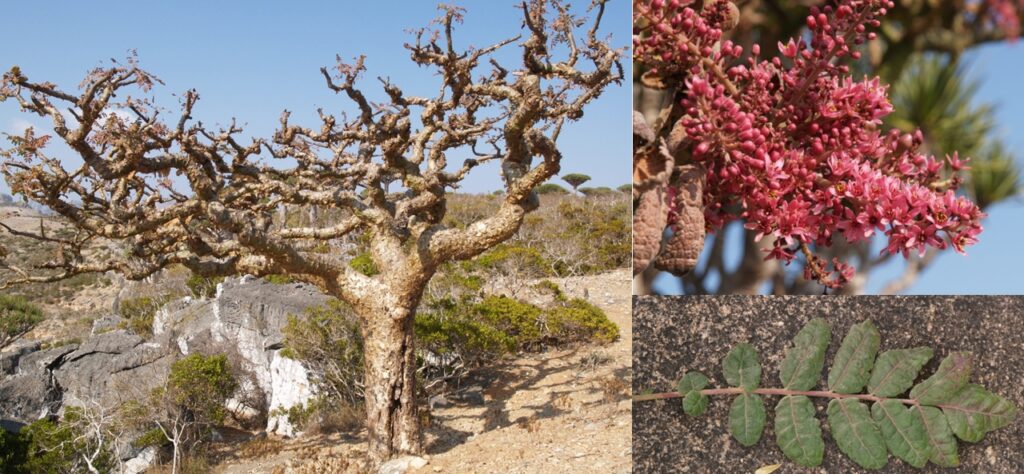

Figure. Boswellia ameero Balf. f.
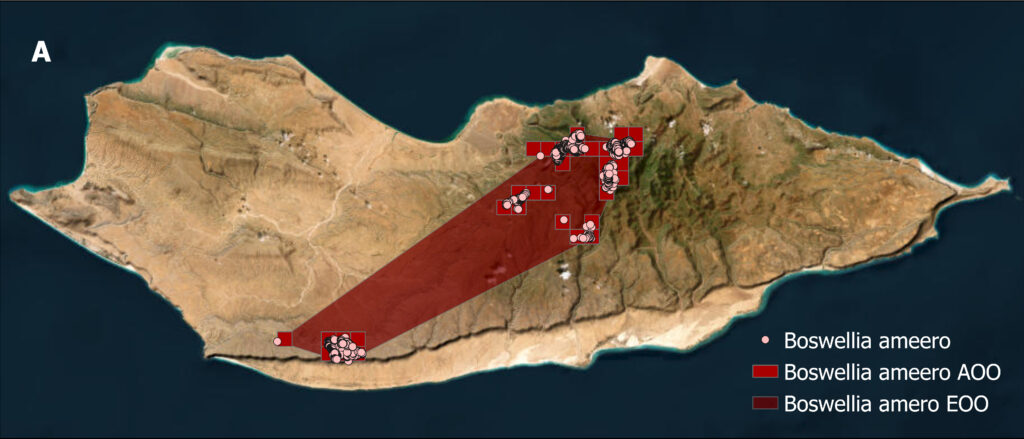
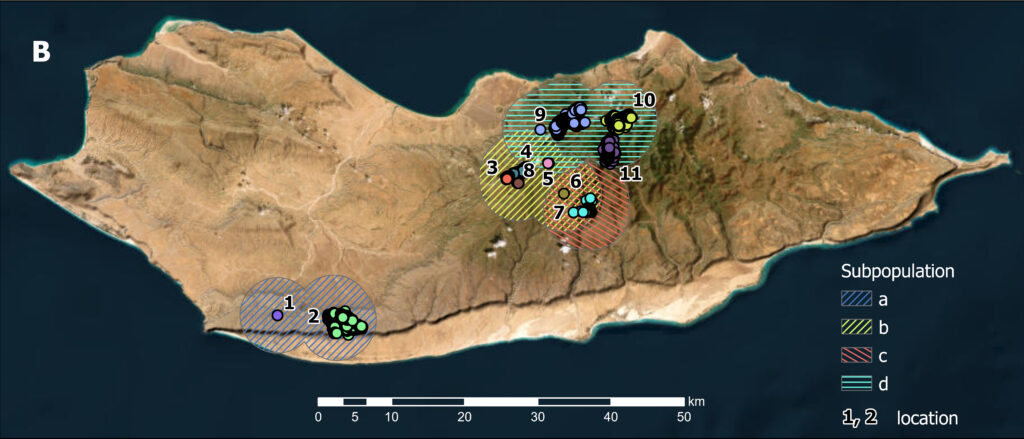
Figure. A: Recorded trees, AOO, and EOO; B: subpopulations and localities of Boswellia ameero in Socotra Island.