II.I.VIII. Boswellia popoviana Hepper
Boswellia popoviana is an endemic species up to 6 meters. The tree is slender with papery peeling bark. Leaves are simple, densely crowded in shoot apices, 3-16 cm long, irregular, crenate or deeply lobed, pubescent beneath. Flowers are pink or reddish growing in panicles or racemes at the end of the foliage period. Fruits are 3-5-locular capsules, narrowly winged.
Boswellia popoviana is a cliff-growing species with a scattered and strongly fragmented distribution; it is relatively widespread on mostly sea-facing steep limestone cliffs and along several valleys penetrating far into the centre of the island (Fig. S8), at a wide altitudinal range of 13–987 m. The AOO is 204 km² and the EOO is 1,879 km². We recognize five subpopulations containing 20 localities, which occur in five threat-defined locations. Many of the stands of B. popoviana consist of only a few individual overmature trees and we can consider several sites as nearly extinct.
The largest subpopulation is on cliffs and boulders along the slopes in the lower regions of Ayheft valley where we counted 1,184 trees, more than one half of all currently assessed individuals. In total, we counted 2,094 trees during recent field surveys, but the inaccessible habitats where this species occurs, makes mapping difficult. The total population size should be estimated up to 4,000 individuals. The population structure contains the highest amount of young trees among all Boswellia species on Socotra Island (Attorre et al. 2011). Due to its ecology, the trees are relatively protected from grazing (on steep rocks), however climate change impacts, grazing and landslides are likely to affect the species strongly in the future. There are also some subpopulations with unusual morphologies and potential hybridisation, for example in the extreme southwest and extreme southeast, which require close examination using molecular methods.
The estimated proportion of the area where it occurs that is affected by overgrazing is 62.5% (42.7% high, 13.6% middle and 6.2% low intensity). In addition, a third of the population occurs near roads (29.9% of the population), and some proportion is affected by resin harvesting (22.7% of the population) and by branch cutting for fodder (16.5%, mostly with low intensity). In B. popoviana, we need to take into account that threat evaluation could be done only for accessible trees (less accessible trees remain without threat evaluation). Also, manifestation of global climate change (heavy rains, long periods of drought) could affect the population in a negative way but there is no direct evidence for this yet, except in Wadi Esgego where recent landslides have occurred due to heavy rains that have affected the local trees. We found about 7% affected by insect pests, relatively high compared to other Boswellia. The species has also been illegally exported and sold in international markets by succulent collectors (personal observation). It is not primarily a species that is commonly locally used for resin extraction (the resin is considered low quality for local use).
According to the IUCN Red List the species is assessed as Endangered – EN B1ab(i,ii,iii,iv,v)+2ab(i,ii,iii,iv,v).
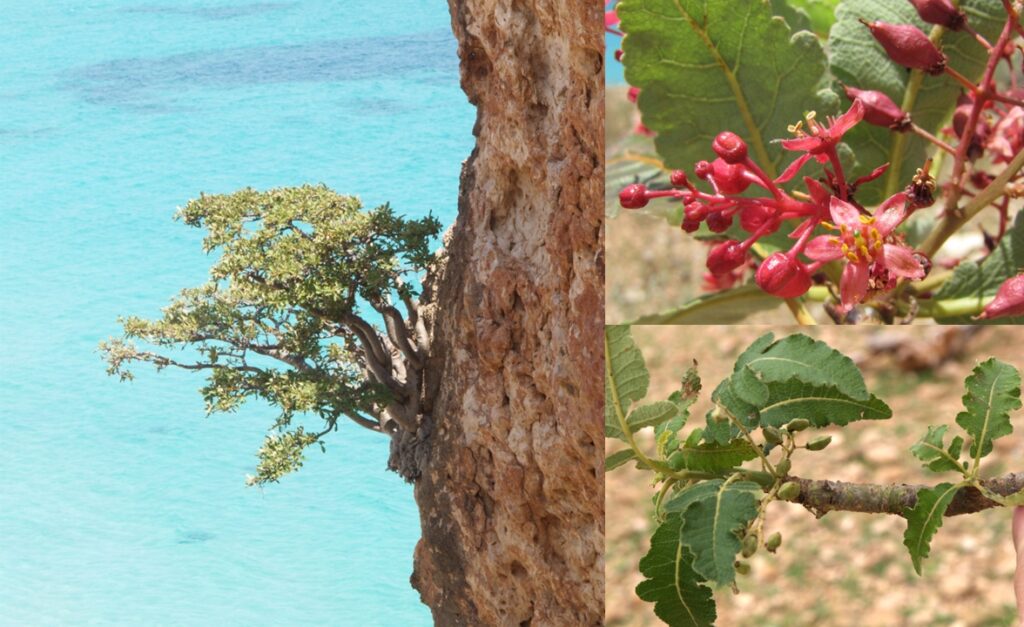
Figure. Boswellia popoviana Hepper
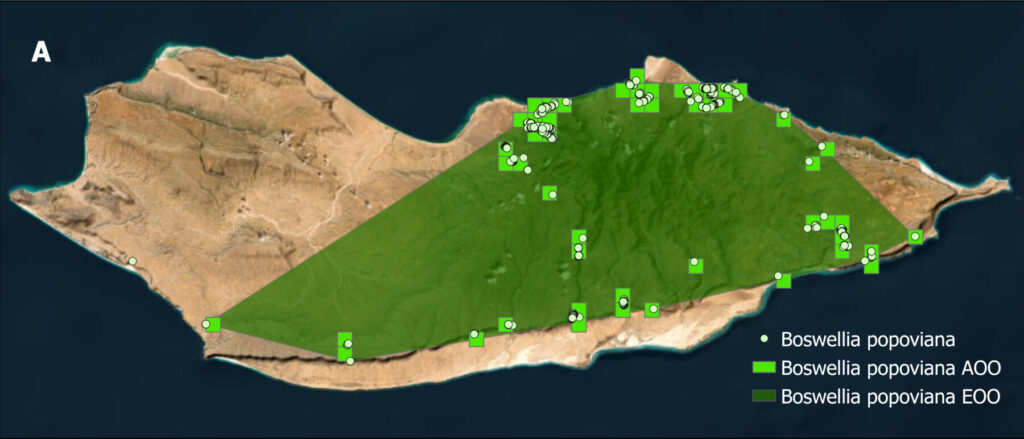
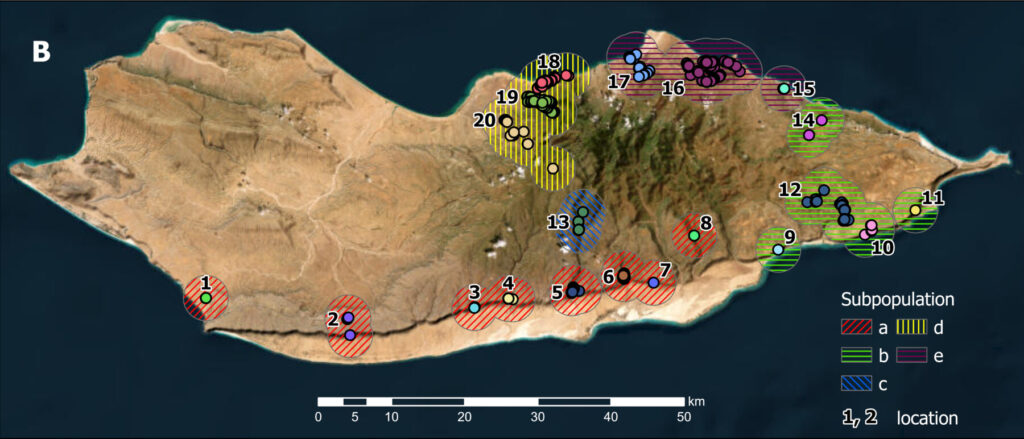
Figure. A: Recorded trees, AOO and EOO; B: subpopulations and localities of Boswellia popoviana in Socotra Island.