II.I.III. Boswellia bullata Thulin
Boswellia bullata is an endemic species on Socotra Island. The tree trunk has a light brown or grey colour with paper-like flakes. Leaves grow in shoot apices, alternate, imparipinnate with 9-19 leaflets, 7-17 cm long. Flowers are cream yellow to light green colour.
Boswellia bullata is a cliff-rooting species with a severely fragmented distribution. It is limited to the northwestern part of Socotra Island. The species is scattered on steep limestone cliffs and on the top of large boulders in dry, semi-deciduous woodland, at an altitude of 0–582 m, including on cliffs exposed to sea spray. The total AOO is 52 km² and the EOO 350 km². There are four subpopulations in five localities, the largest is situated on the slopes of the mountains near Qalansiyah which counts 197 trees, containing less than half of the total currently inventoried. We consider 4 threat-defined locations (Fig. S3). The total number of trees currently recorded in the island is 491, however we estimate that the total population size could reach 1,000 individuals, as many individuals occur on hardly accessible cliffs and are difficult to see. In some subpopulations, a few juvenile trees and seedlings were observed. However, local cyclones in 2015 and 2018 destroyed many adult trees, for example near Qalansiyah. All individuals of B. bullata are found within 2 km of the coast, and on slopes of high inclination (median around 40 degrees).
The most commonly recorded threat for B. bullata is intensive grazing by goats which was observed in all localities; the estimated proportion of the trees most directly affected is 60.8% (of which 35.2% high intensity). This mainly affects young trees, as adult individual trees are rarely browsed because they grow in largely inaccessible places (rocks, cliffs). These trees are not often used for resin; the estimated proportion of the population affected by direct resin harvesting is 25.0%, (23.8% low intensity), by branch cutting for fodder during dry periods 13.8% (11.2% low intensity), and 5.7% of the population is threatened by landslides. The small, isolated stands of this species are highly sensitive to global climate change; the cyclones in 2015 destroyed many trees (not recorded formally at the time, but observed by local people). We can assess a future decline of the fragmented stands of this species, due to mortality of (over)mature trees and grazing pressure resulting in a lack of regeneration. The species has also been illegally exported and sold in international markets by succulent collectors (personal observation).
According to the IUCN Red List the species is assessed as Endangered – EN B1ab(iii,v)+2ab(iii,v); C2a(i).
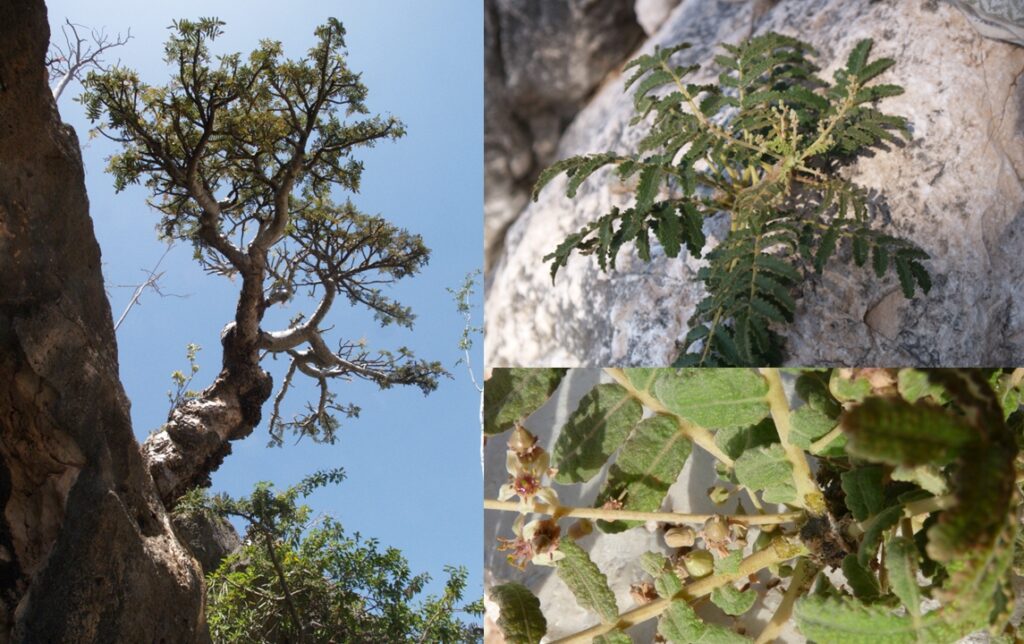
Figure. Bowellia bullata Thulin
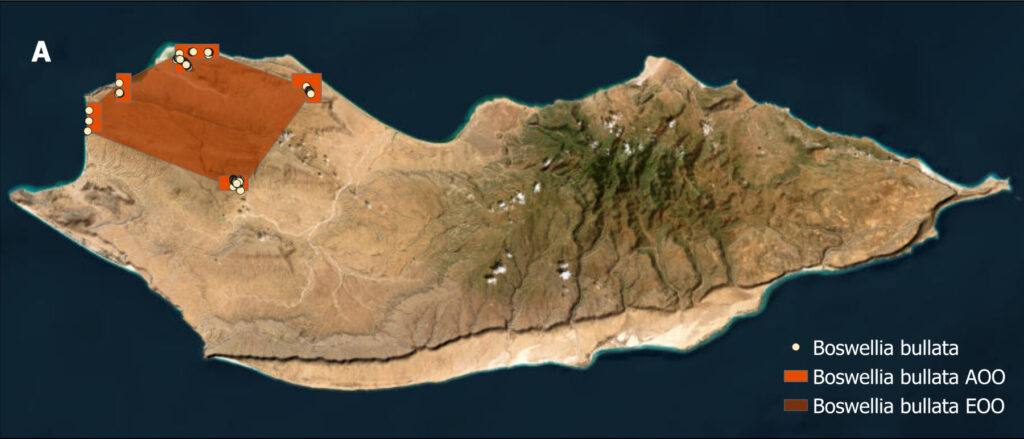
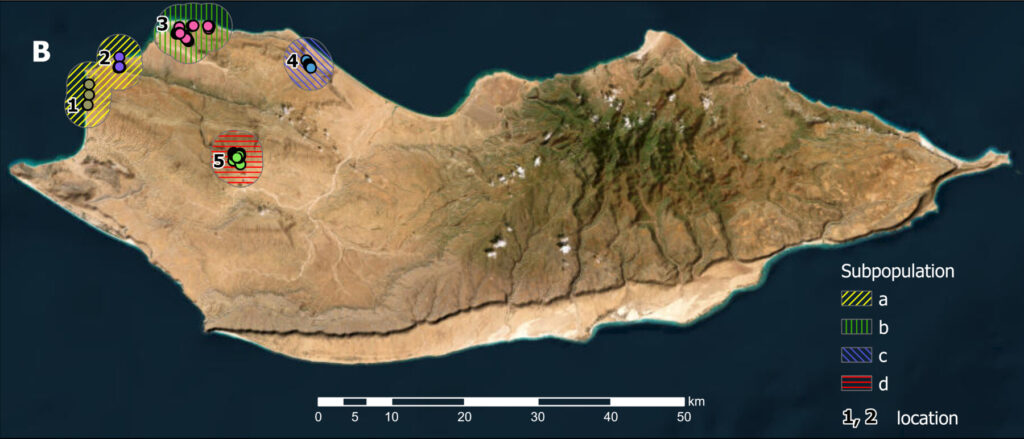
Figure. A: Recorded trees, AOO and EOO; B: subpopulations and localities of Boswellia bullata in Socotra Island.