II.I.XI. Boswellia socotrana subsp. apsleniifolia (Engl.) Lvončík
Boswellia socotrana subsp. asplenifolia is an endemic species to Socotra Island. Subspecies of B. socotrana s.l. (Lvončík & Řepka, 2020), considered a full species as B. aspleniifolia by Thulin (2020). The tree is deciduous, growing up to 8 m. Leaves are imparipinnate growing in shoot apices, reddish when young with 7-23 leaflets, 1-7 cm long, and 1-4 teeth or lobes. Flowers are cream or pale yellow and fruits are 3-4 locular, subglobose with an apical point, not winged. The species grows on cliffs and rocks at 0-250 m above sea level. When growing on limestone subbase, it could occur as a dwarf plant. On Socotra, the species is used in traditional medicine and as a fodder for goats during the dry season.
Boswellia socotrana subsp. aspleniifolia is a ground-rooting tree restricted to Socotra Island where it is distributed in dry, semi-deciduous woodland, relatively less common (yet present) in Croton socotranus shrubland which occurs at altitudes of 14–567 m. The AOO is 164 km² and the EOO is 803 km². Boswellia socotrana subsp. aspleniifolia occurs in valleys, lowland plains, and hills in the northern and central parts of the island where we found it in eight localities, which correspond to about four subpopulations, two of which are strongly relictual with only very 2-3 trees that can be considered as nearly extinct. Distribution is fragmented, subpopulations are disjunct, with also a disjunct western and eastern occurrence on the island; we suggest 4 threat-defined locations corresponding to the 4 subpopulations. In total, we counted 3,266 trees, but we estimate up to 4,000 individuals for the entire island. The most numerous core subpopulation is in the plains of Shata Qalansiyah, where 2,181 specimens were counted; large and dense stands can also be found in the lower parts of Terubeh and Ayheft valleys (Table S2). Most localities show over maturation and nearly no sign of natural regeneration as these trees occur in areas with high intensity of goat grazing, therefore we interpret the population trend as slowly declining. We observed natural seedlings in some areas, like in Shata Qalansiya, but these were gone within one to two years by grazing.
Major threats of B. socotrana ssp. aspleniifolia include overgrazing, branch cutting (for fodder), climate effects (cyclones) and infrastructure development in lowland areas. Overgrazing is estimated to affect 76.7% of the total population (46.2% high, 19.3% middle and 3.8% low intensity), branch cutting (use as fodder for livestock) affects 41.8% (2.8% high, 12.9% middle and 26.1% low intensity). Resin harvesting is observed for 38.4% of the total population (3.8% high, 7.3% middle and 27.3% low intensity). For 8% of the trees, new wounds were observed, which is anexception in comparison to the other Boswellia species where only naturally occurring resin is collected (without tapping the trees, so there is no damage to the tree). The species has also been illegally exported and sold in international markets by succulent collectors (personal observation). Climate effects are considered to have a strong effect on this tree, as many individuals in lowlands were uprooted by the cyclones that affected Socotra in 2015. The largest subpopulation (Shata Qalansiyah) is also threatened by potential infrastructure development in the future which is common in the lowlands of Socotra (35.2% of the entire population is near roads).
According to the IUCN Red List the species is assessed as Endangered – EN B1ab(i,ii,iii,iv,v)+2ab(i,ii,iii,iv,v).
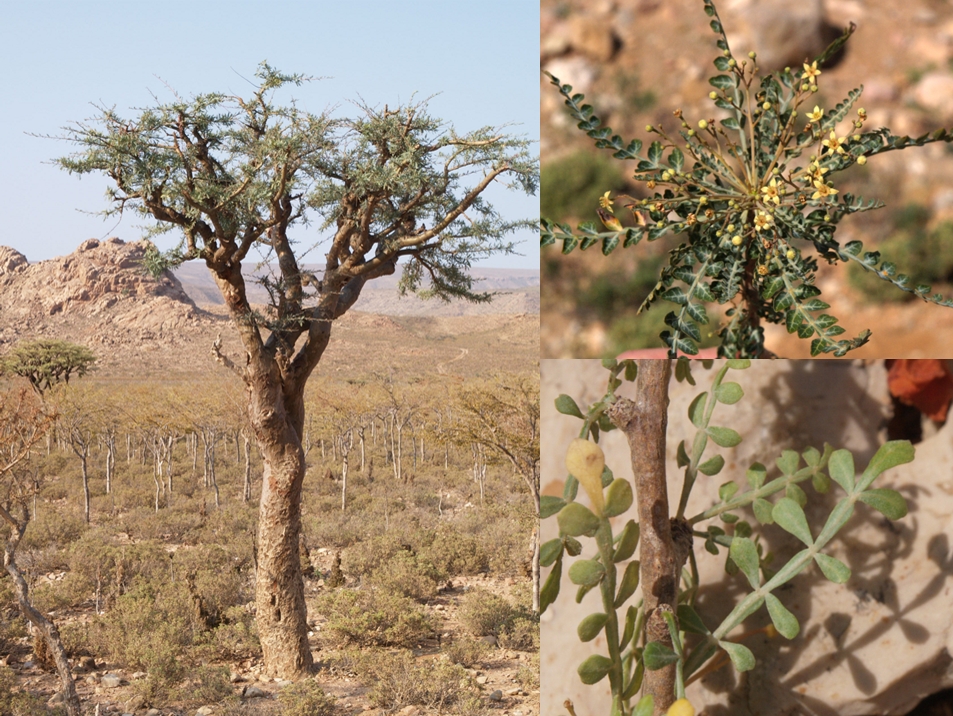
Figure. Boswellia socotrana subsp. asplenifolia (Engl.) Lvončík
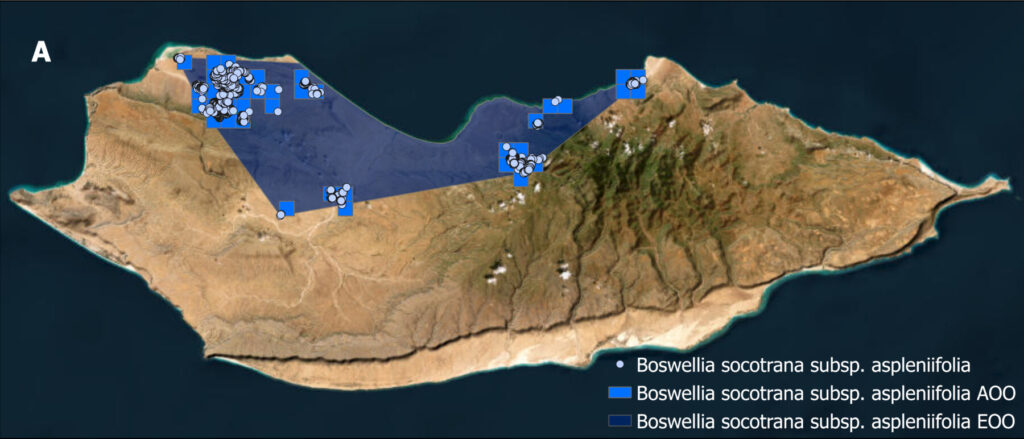
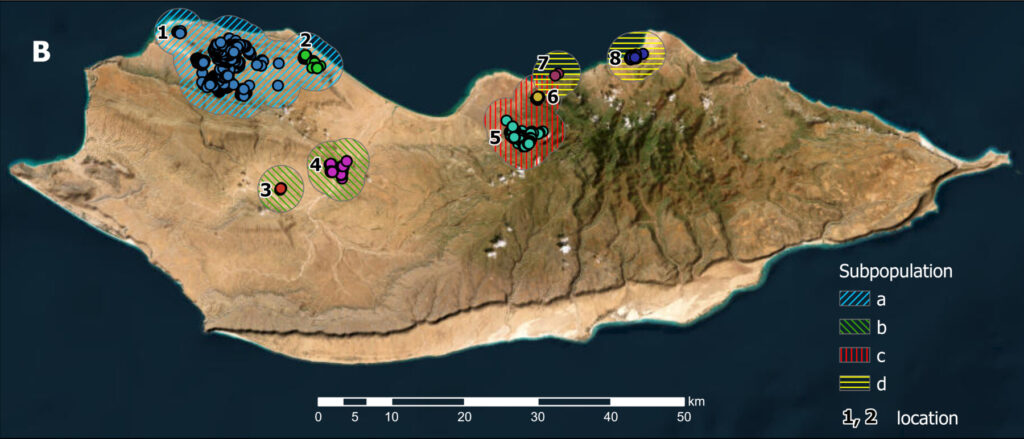
Figure. A: Recorded trees, AOO and EOO; B: subpopulations and localities of Boswellia socotrana subsp. aspleniifolia in Socotra Island.