II.I.VI. Boswellia hesperia Thulin
Boswellia hesperia occurs on limestone plateaus and cliffs in sparse dry, semi-deciduous woodland in the most southwestern part of the Socotra Island, at an altitude of 389–413 m. It is a very rare dwarf species, described recently, a provisional species only described on photographs by Thulin (2020) and for science later (Thulin et al. 2025). Originally it was considered by Miller & Morris (2004) and Lvončík et al. (2013) as a dwarf prostrate form of Boswellia popoviana. Currently there are only three localities corresponding to two-three small subpopulations known, respectively with 273, 57, and 4 specimens. The AOO is 16 km² and EOO 10 km2 and we consider all subpopulations occurring in a single threat-defined location. As this plant has a dwarf habitus, it is easily overlooked and there is a high probability to find more individuals on the vast southwestern plateaus. We estimate the (accessible) population to be about 1,000 individuals, but more can be present in inaccessible areas. The population trend is not known well, because only one locality was mentioned by Miller & Morris (2004), and more were found during our field assessments. Most likely it is also affected by goat browsing, as we observed overgrazing in 100% of the areas where it occurs. It is directly threatened by illegal succulent collectors which are interested in new species absent in collections.
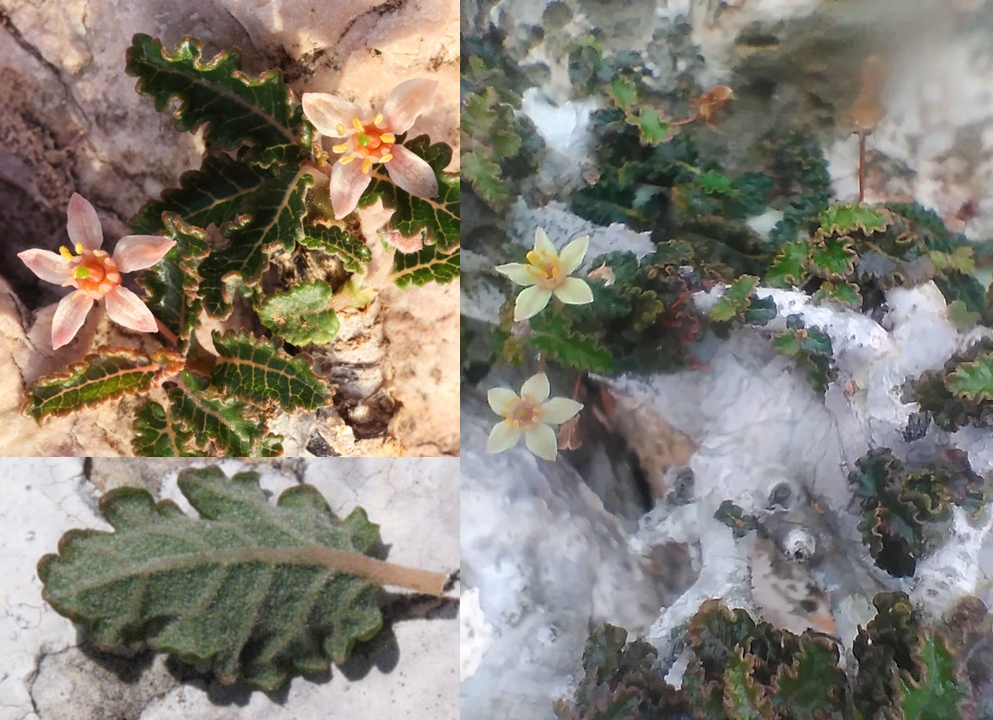
Figure. Boswellia hesperia Thulin
According to the IUCN Red List the species is assessed as Critically Endangered – CR B1ab(iii).
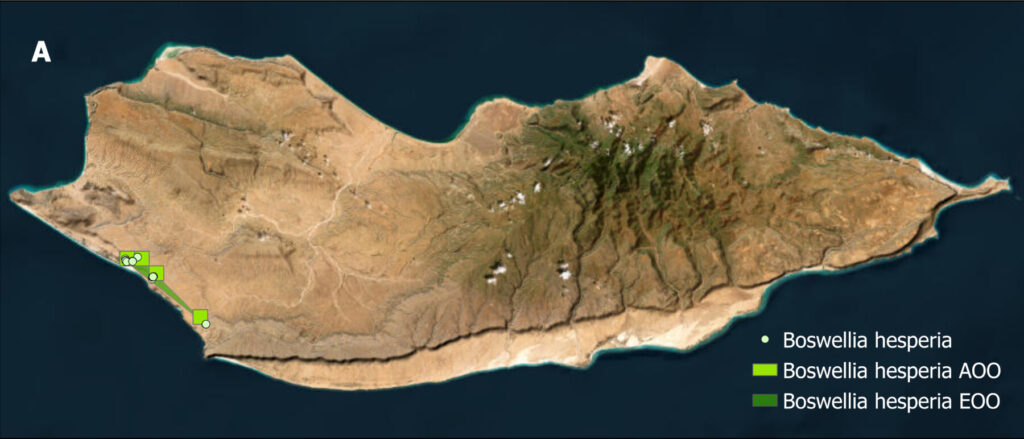
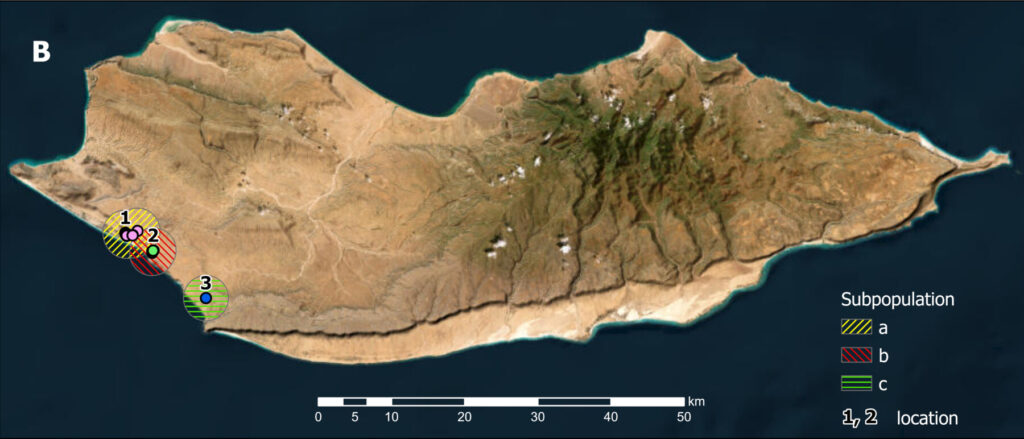
Figure. A: Recorded trees, AOO and EOO; B: subpopulations and localities of Boswellia hesperia in Socotra Island.