II.I.V. Boswellia elongata Balf. f.
The tree grows up to 8 meters, Leaves are imparipinnate with long 13-29 leaflets or simple 20 × 4.5 cm. Flowers are yellow, pale green to pinkish, growing in racemes or panicles. Fruits are 4-5 locular capsules with 5 seeds.
Boswellia elongata is the most widely distributed Boswellia species (together with B. popoviana) of Socotra Island, although occurring in severely fragmented stands; it is a ground-rooting species widely scattered in dry, semi-deciduous woodlands (relatively less common, yet present, in succulent shrubland). It is found on both limestone and granitic substrates, at altitudes ranging between about 100 to 800 m (85-838 m). It is one of the few Socotran Boswellia species with a median occurrence at relatively higher altitudes (median between 300-400 m). The AOO is 296 km² and the EOO 2,388 km². This species has a scattered and strongly fragmented distribution with many relictual disjunct stands in open woodland, lacking natural regeneration. We identified six isolated subpopulations in about 24 localities. We can consider six threat-defined locations for B. elongata which correspond to the subpopulations.
In total we inventoried 3,951 trees (in 2020-2023), however we estimate there are at least 5,000 trees in total. Many stands count only one or a few specimens (especially in the west), like in the Haggeher and Momi are larger (Table S2). Small localities can be considered as nearly locally extinct, as each year the mature trees are declining and there is no regeneration (Lvončík et al., 2020). The pattern of distribution and overmaturity of the stands strongly suggests a decline in the extent and quality of its habitat. Besides maturity and lack of regeneration, this species has heavily been affected by cyclones, which has strongly decreased individual stands, for example in Homhil where the majority of B. elongata trees are gone as a direct consequence of climate change and subsequent attack by insect pests (Lvončík et al., 2020). More than half of the entire population of B. elongata is in isolated subpopulations isolated from the largest subpopulation in the Haggeher (Table S2), so the species is severely fragmented.
The recorded main threats include impacts of overgrazing, climate change (Lvončík et al., 2020), and also potential impact from nearby settlements. The estimated proportion of the trees damaged by strong winds is 6.7% in the last ten years (mostly by cyclones in 2015 and more affecting some areas than others, for example in Homhil), 3,8% of the population is endangered by potential settlement expansion and 20% by nearby roads. We found about 1% of the total population to be recently uprooted, and about 5% affected by pests. Resin harvesting (mostly low intensity) was recorded in 26.6% of the entire population. Overgrazing was recorded as the highest risk for Boswellia elongata populations; the estimated proportion of the population affected by overgrazing in the areas where it occurs is 66.3% (40.9% high, 19.0% middle and 6.4% low intensity). Also, silvopastoral practices such as direct branch cutting for livestock fodder have a strong impact, affecting 46.6% of the entire population (2.5% high, 15.1% middle and 29.0% low intensity). This species has a wide range of ethnobotanical purposes and is also important for honey locally (Miller & Morris, 2004). The species has also been illegally exported and sold in international markets by succulent collectors (personal observation).
According to the IUCN Red List the species is assessed as Endangered – EN B1ab(i,ii,iii,iv,v)+2ab(i,ii,iii,iv,v).
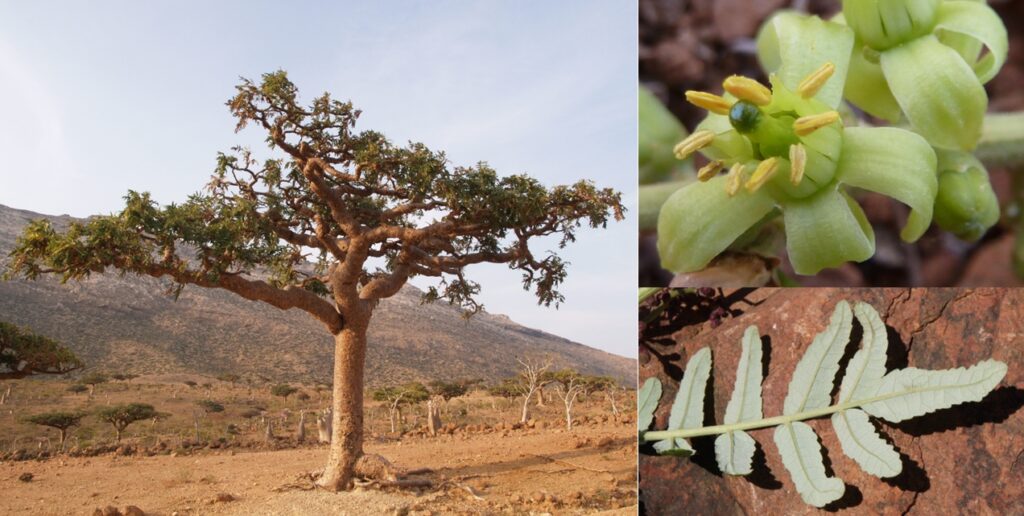
Figure. Boswellia elongata Balf.f.
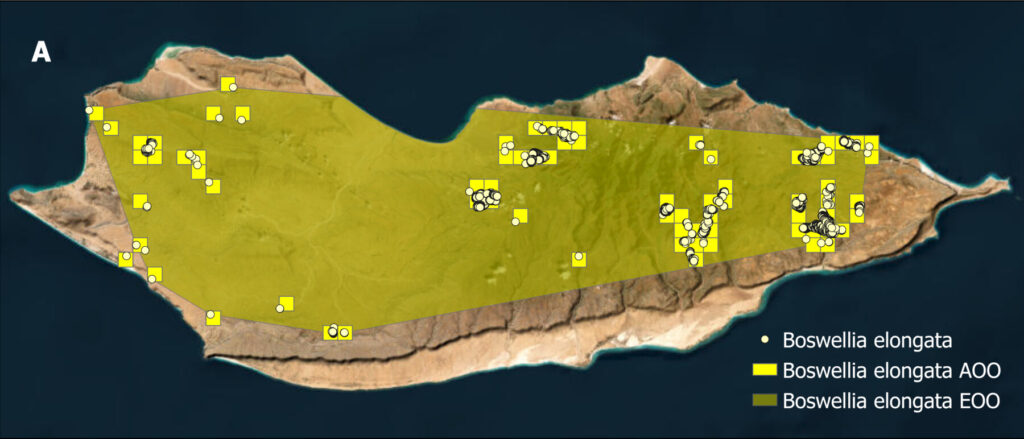
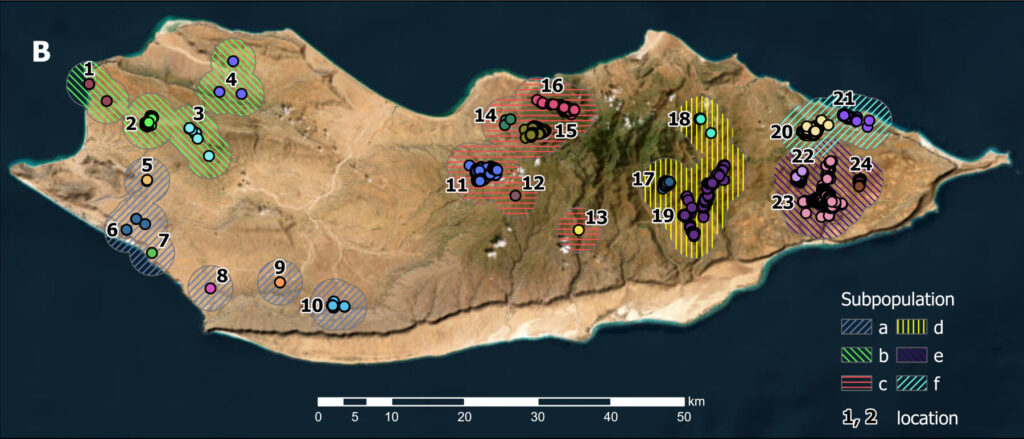
Figure. A: Recorded trees, AOO and EOO; B: subpopulations and localities of Boswellia elongata in Socotra Island.