II.II.I. Commiphora ornifolia (Balf.f.) J.B. Gillet
Commiphora ornifolia is an endemic tree species of Socotra Island. Among the four Commiphora species occurring on the island, it is morphologically and ecologically distinct from the others, representing probably a different evolutionary lineage within the genus on Socotra.
The species is a tree reaching up to 10 m in height. The trunk is covered by a light grey smooth bark, moderately exfoliating in irregular patches. It exudes a gummy resin lacking a strong scent; the resin is initially white and gradually turns amber-coloured upon exposure. Leaves are alternate and clustered at the ends of branches; they are pinnately compound, composed of 3–7 leaflets. Leaflets are ovate to broadly elliptic, 4–9 × 2–6 cm, entire, and glabrous to slightly pubescent or velvety. The flowers are small (c. 5 mm), violaceous, and arranged in raceme-like cymes. The fruits are fleshy, globose, approximately 10 mm in diameter, light green when immature and turning reddish at maturity.
The species is widely and relatively uniformly distributed across the island. It is most frequently found in semi-deciduous woodland, particularly on limestone escarpments and in wadis, while it is less common in succulent shrubland. Commiphora ornifolia occurs from near sea level (c. 10 m a.s.l.) up to 700 m, with rare individuals recorded at elevations of up to 1,050 m.
The species is grouped into 10 threat-defined locations, considering severe cyclones as the most plausible rapid threat. Based on spatial clustering of suitable habitats nine subpopulations are recognised. A total of 587 individuals have been directly recorded. Given the broad distribution of the species, the presence of suitable but incompletely surveyed habitats, and the likelihood of undetected individuals in remote or inaccessible areas, the total population size is conservatively estimated to comprise approximately 9,000–10,000 individuals, with the majority assumed to be mature individuals due to the limited regeneration observed across much of the species’ range. Evidence of regeneration is scarce and highly localised; in several areas, juvenile trees and seedlings are entirely absent, primarily due to intense grazing pressure by free-ranging goats. The area of occupancy (AOO) is 440 km². The extent of occurrence (EOO), is estimated at 3,109.6 km².
The principal threat to C. ornifolia is intensive grazing by goats, which severely limits regeneration by consuming seedlings and young plants. Resin collection does not currently represent a significant threat to this species, and branch cutting for fodder appears to be limited and localised. Natural threats include cyclones and associated landslides or rockfalls, which can cause localised mortality, particularly in exposed or steep habitats.
Habitat quality is inferred to be in continuing decline as a result of chronic overgrazing, compounded by increasing aridity and the intensification of extreme climatic events. A continuing decline in population size is inferred from the near absence of successful recruitment outside of inaccessible refugia, suggesting long-term demographic attrition. Species distribution modelling under a high-emissions climate scenario (SSP5-8.5, 2081–2100) projects a future population reduction of approximately 7.8%, driven by a reduction in climatically suitable area and a consequent decline in area of occupancy and habitat quality. This estimate is conservative, as it does not account for ongoing non-climatic pressures such as overgrazing.
According to the current IUCN Red List assessment, Commiphora ornifolia is classified as Near Threatened (NT). However, based on newly collected data indicating continuing habitat degradation, limited regeneration, and projected future declines, the species would likely qualify as Vulnerable (VU) under criteria B1 and B2.
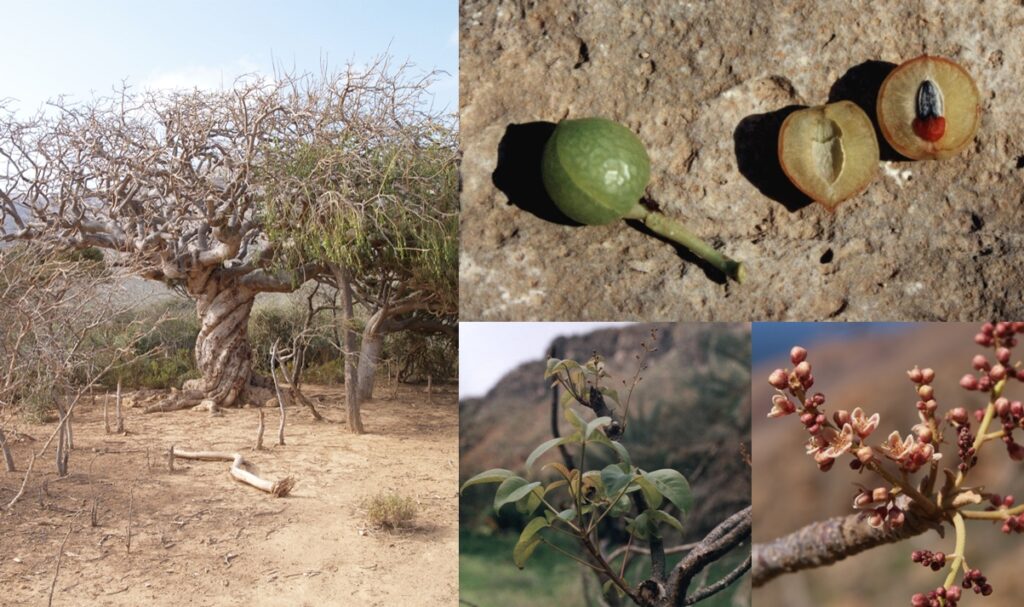
Figure: Commiphora ornifolia (Balf.f.) J.B. Gillet
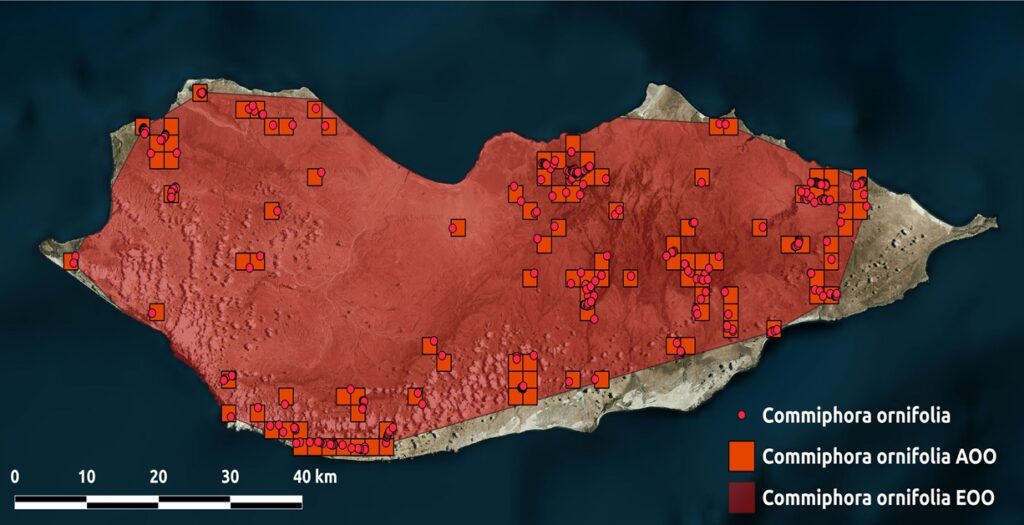
Figure: AOO and EOO of Commiphora ornifolia showing the area of distribution of this endemic species