II.I.IV. Boswellia dioscoridis Thulin
Boswellia dioscoridis is an endemic tree on Socotra Island, growing up to 7 meters with a yellowish-brown trunk and leaves densely placed in shoot apices, imparipinnate ovate-oblong, 12-40 leaflets, 8-30 cm in size, finely pubescent at the veins. Flowers are cream to yellow, sometimes pink in colour and fruits are 3-5 locular. B. dioscoridis is the only tree on Socotra Island with glabrous leaves and inflorescence.
Boswellia dioscoridis is a cliff-rooting species that grows on limestone cliffs in dry, semi-deciduous woodland in predominantly the eastern half of Socotra Island, at altitudes of ca. 50-700 m. The AOO is 80 km² and the EOO is 536 km². The distribution is strongly fragmented, and we suggest six subpopulations over as many localities and 4 threat-defined locations. In total we inventoried 544 specimens on Socotra, yet the entire population could reach up to ca. 2,000 trees. The largest and most numerous subpopulation is in Esgego Valley and the adjacent Firmihin Plateau, where we counted 177 trees and estimate about 1,000 in total. The smallest remnant subpopulations contain only 8 (Malaghan) and 9 (Shibhon) trees. Small seedlings are found in rock crevices in some localities, however overgrazing by goats does not allow proper regeneration in accessible places.
The species is mainly threatened by overgrazing and climate change effects. The estimated proportion of the total areas where the species occurs is affected by overgrazing in 75.4% (53.1% at high intensity, 17.5% at mid-intensity and 4.8% at low intensity). The proportion of the population affected by resin harvesting is 46.0%, but mostly low intensity (41.0%); branch cutting for fodder affects about 41.5% in total (31.0% low, 10.0% middle and 0.5% high intensity). In addition, 27.1% of the currently assessed population is endangered by road construction (road through the largest subpopulation, from Shibhon to Firmihin, intensively used for tourism in this area). The core subpopulation in Esgego valley and the adjacent Firmihin Plateau was strongly affected by climate events (cyclones) in 2015, where also large landslides occurred, and all subpopulations can be considered as declining (without healthy regeneration, missing offspring). The species has also been illegally exported and sold in international markets by succulent collectors (personal observation).
According to the IUCN Red List the species is assessed as Endangered – EN B1ab(i,ii,iii,iv,v)+2ab(i,ii,iii,iv,v).
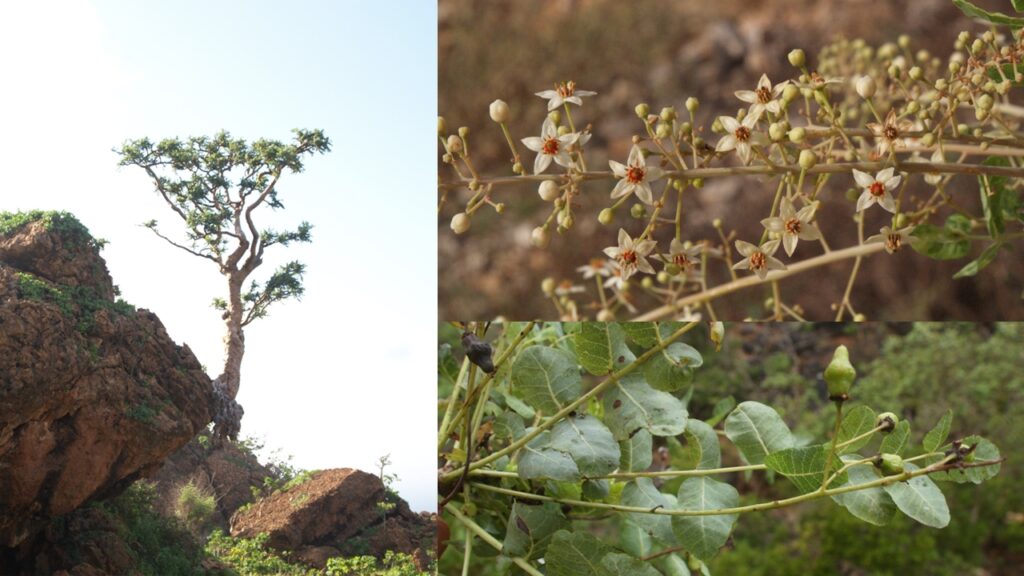
Figure. Boswellia dioscoridis Thulin
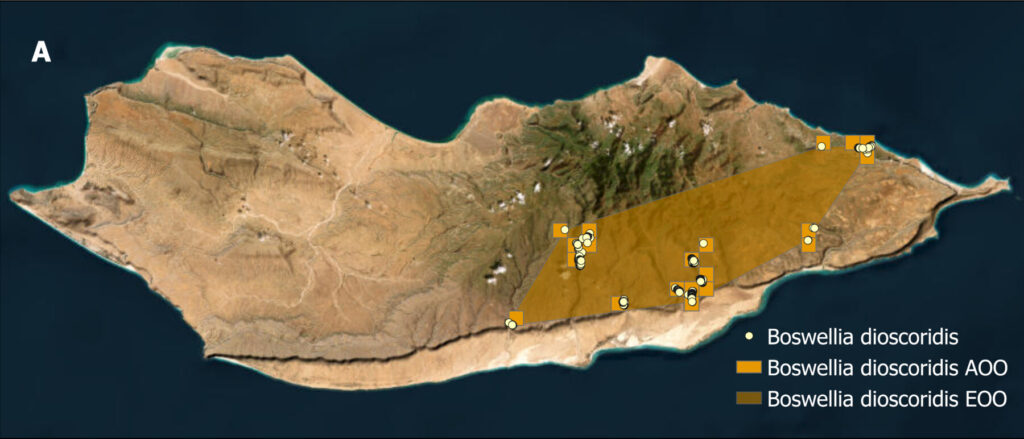
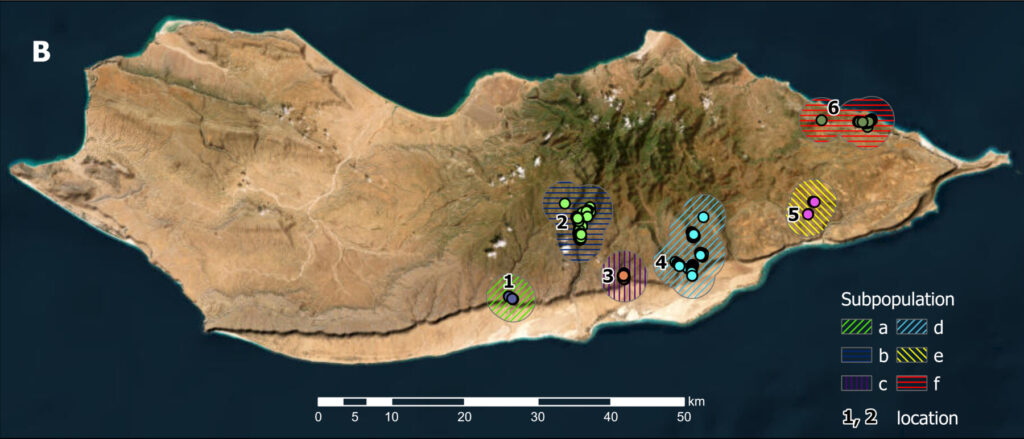
Figure. A: Recorded trees, AOO and EOO; B: subpopulations and localities of Boswellia dioscoridis in Socotra Island.