II.I.VII. Boswellia nana Hepper
Boswellia nana is an endemic species on Socotra Island. The name “nana” refers to the habit of the tree, up to 2 m in total. The trunk is grey, often covered by crustose lichen (Pullaiah et al., 2023). Leaves are simple, 4 cm in size, irregularly crenate-undulate, and densely crowded in shoot apices. Pink or reddish, glabrous flowers grow in unbranched inflorescence. Fruits are 3-4 locular capsules.
Boswellia nana is a very rare endemic of Socotra Island, growing exclusively on limestone cliffs in dry, semi-deciduous woodland. It is restricted to the northeast of the island where it occurs at altitudes between 226 and 710 m on steep cliffs (median 45° slope). The AOO and EOO are 40.0 km². We found B. nana at seven localities, which correspond to two different subpopulations. The species is found from the Hamadero highland to the most eastern part of the island (with a disjunct subpopulation at the northern sea-facing cliffs at Riy di Irisseyl). As the species occurs in a very limited geographical area and narrow altitudinal zone on the north-facing eastern limestone cliffs of Socotra Island, a single (e.g., drought or disease) event could affect the entire species, therefore there is only one threat-defined location. The largest population is near Erher cliffs where 118 specimens have been counted. Due to the inaccessible terrain and the cliff-growing ecology of the species, the number of individuals (354 individuals are currently known) is likely an underestimation, and the total number could reach ca. 700 individuals. Mostly the species is known as a small dwarf form, but towards the eastern extreme at Irisseyl we also observed actual trees (these are under investigation).
The population trend is not known, because until 2004 only two sites were recorded for B. nana (Miller & Morris, 2004) and our survey has increased our knowledge of the number of localities and mature individuals. This species grows on cliff faces, habitats that are quite inaccessible even for goats, yet in accessible areas grazing does not allow regeneration. Future continuing decline in mature individuals due to grazing and climate change is realistic. We find no young trees and the individuals grow in a specific area with horizontal precipitation – any small change to the climatic conditions here, will affect this species further.
Overgrazing occurs in 37.7% of the area where B. nana occurs (16.5% high, 16.0% middle and 5.2% low intensity). However, our assessments are mainly done in relatively accessible areas and this plant grows mainly on steep cliffs that goats (and researchers) cannot reach. Grazing in more accessible areas will prevent seedlings to grow easily. Global climate change effects (heavy rains, long periods of drought) could affect the population in a negative way in the future, but there is no direct evidence for this yet. The species has also been illegally exported and sold in international markets by succulent collectors (personal observation).
According to the IUCN Red List the species is assessed as Critically Endangered – CR B1ab(v).
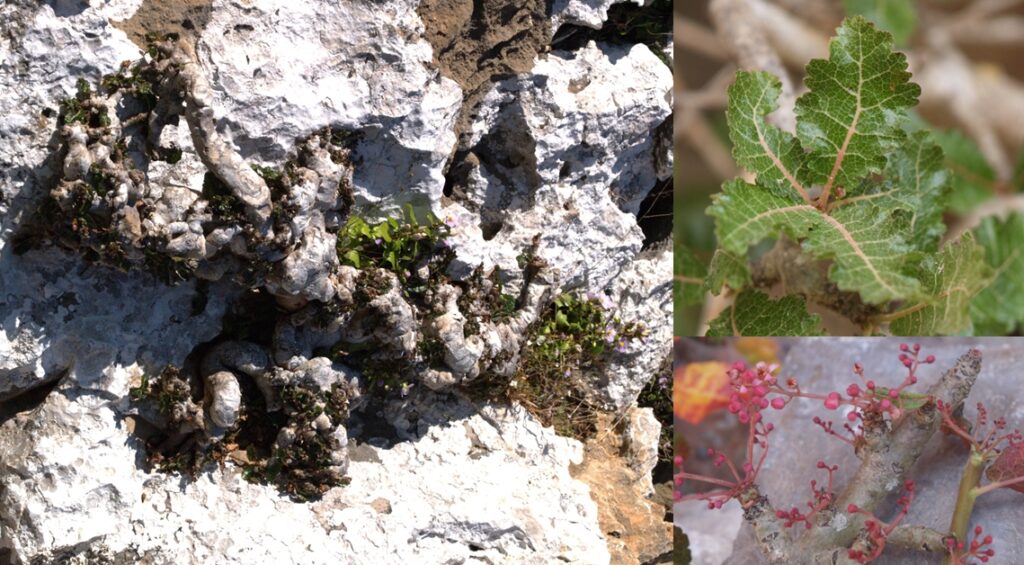
Figure. Boswellia nana Hepper
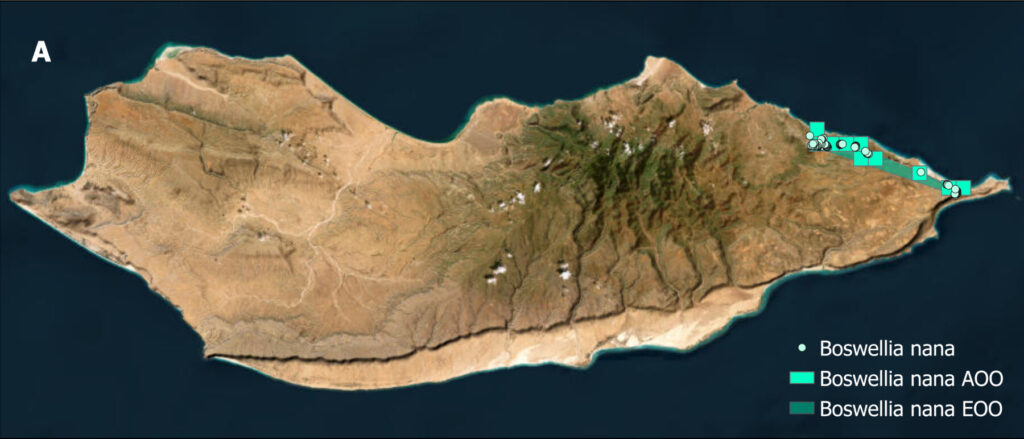
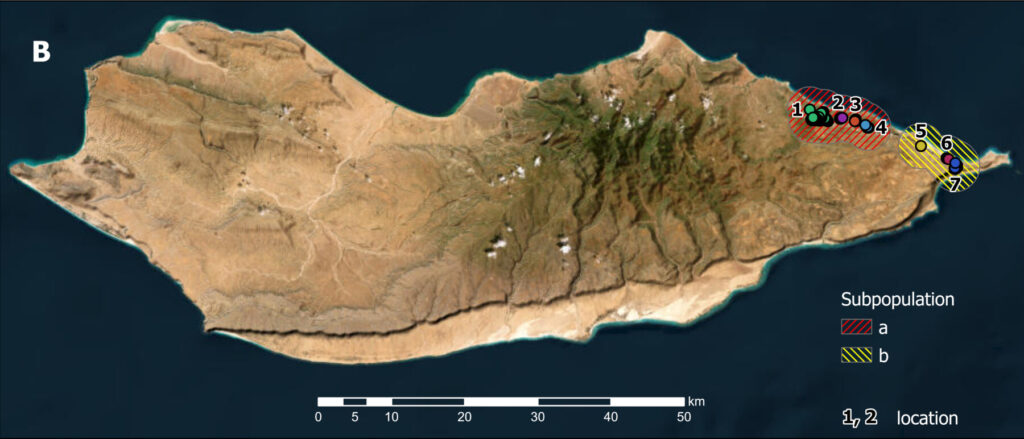
Figure. A: Recorded trees, AOO and EOO; B: subpopulations and localities of Boswellia nana in Socotra Island.