II.I.XI. Boswellia socotrana subsp. socotrana Balf.f.
Boswellia socotrana subsp. socotrana is an endemic ground-rooting species with a limited area of occupancy on Socotra Island. It is medium-sized up to 8 m. Leaves are very specific, growing in dense shoot apices, imparipinnate with 7-31 leaflets, 1-10 cm long, and winged. Pale, yellow flowers grow in glabrous racemes or panicles. Fruits are 3-4 locular, subglobose capsules.
Boswellia socotrana subsp. socotrana (or B. socotrana s.str.) only occurs in the eastern half of Socotra Island in dry, semi-deciduous woodland, at an altitude of 45–627 m, predominantly on granite and limestone substrates. The AOO is 68 km² and the EOO 436 km². We found 7 relatively isolated stands which comprise of ca. 5 subpopulations and as many (5) threat-defined locations. There are medium-sized stands at the Hamaderoh-Homhil slopes and higher Zorkin (or Zerkine) areas, as well as some very small (relictual) subpopulations in Di Negehan (Daneghan) valley and in Firmihin.
The largest subpopulation of B. socotrana ssp. socotrana is in Ayheft valley where we counted at least 1,420 trees; considering the density of the stands, the real number is likely higher. The latter subpopulation is in relatively good condition, with some regeneration. We counted 1,822 trees in the entire island, and we estimate about 2,500 individual trees in total. Except for the largest subpopulation in Ayheft valley, the other localities have overmature trees with no regeneration due to overgrazing by goats, and the fragmented population is declining, with several subpopulations too small to be viable.
Overgrazing can be considered as a major threat to Boswellia socotrana subsp. socotrana which occurs in heavily grazed areas, affecting an estimated 86.6% of the entire population (70.5% high, 13.2% middle and 2.9% low intensity). Branch cutting (as fodder for livestock), is estimated to affect 65.9% of the population (11.2% high, 27.3% middle and 27.4% low intensity). This is one of the locally most coveted species for incense (Miller & Morris, 2004), and harvesting is estimated to affect 11.7% of the trees, yet it does not pose a high risk because only naturally occurring resin is collected (without tapping the trees). Climate change effects form a major threat, as cyclones uprooted an unknown proportion of the trees in 2015, in addition the estimated proportion affected directly by wind (causing damage to the crown) is 4.9%, and landslides threaten ca. 3.6% of the trees. The largest subpopulation in Ayheft valley may be impacted by vicinity to roads (10.6%) and occurs near local settlements (61.8%). The species is also illegally exported and sold in international markets by succulent collectors (personal observation).
According to the IUCN Red List the species is assessed as Endangered – EN B1ab(i,ii,iii,iv,v)+2ab(i,ii,iii,iv,v).
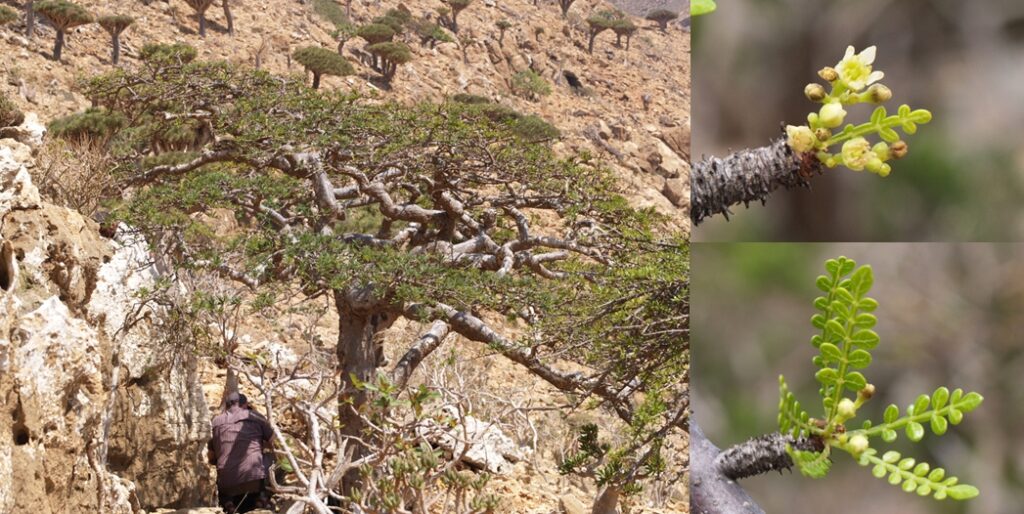
Figure. Boswellia socotrana subsp. socotrana Balf.f.
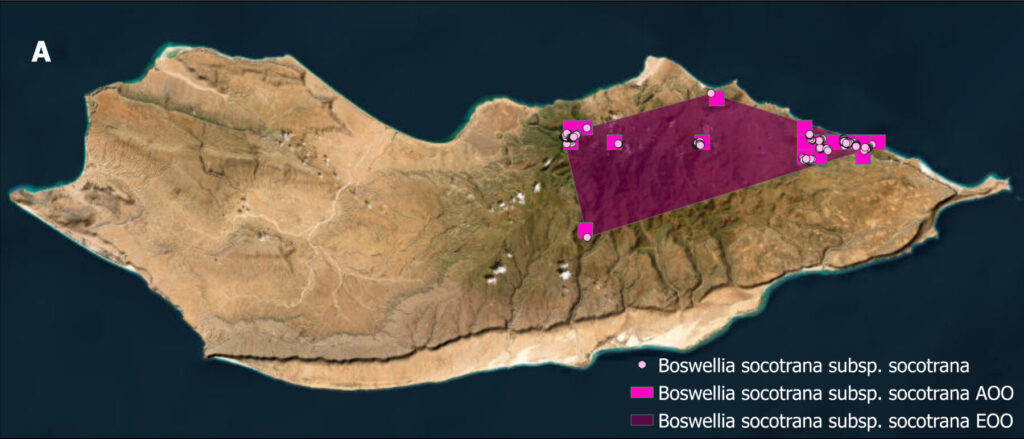
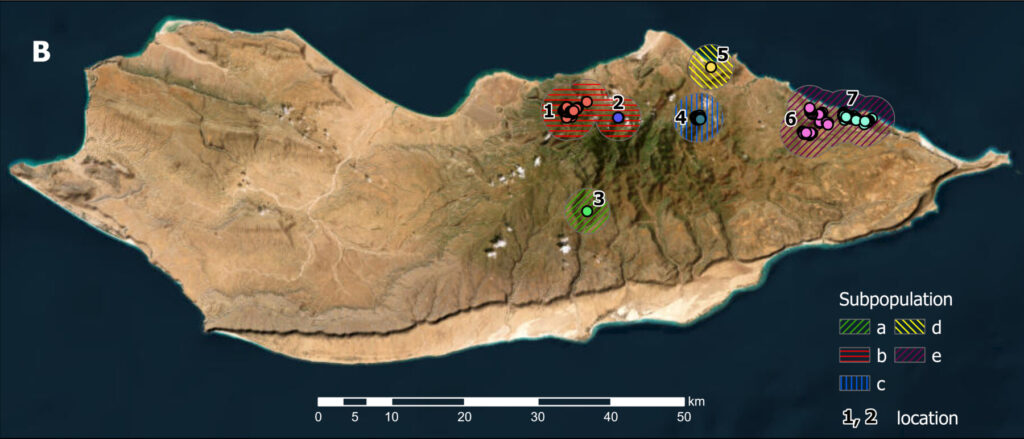
Figure A: Recorded trees, AOO and EOO; B: subpopulations and localities of Boswellia socotrana subsp. socotrana in Socotra Island.