II.II.II. Commiphora parvifolia (Balf.f.) Engl.
Commiphora parvifolia is a tree species endemic to Socotra Island. Phylogenetically, the species is likely affiliated with the Spinescens clade as defined by Gostel et al. (2016).
The species is a small tree reaching up to 4 m in height. The trunk is covered by a smooth, non-exfoliating bark of a dark grey colour, sometimes with a plum-like hue. The bark exudes an aromatic, amber-coloured resin. Leaves are alternate and clustered on short spur branches; they are pinnate and composed of (3)7–11 leaflets. The leaflets are entire, glabrous, oblong, and small, measuring 1–6 mm in length. Flowers are solitary, small (c. 4 mm), initially yellowish-green and becoming reddish with age; the species is dioecious. Fruits are ovoid to globose, measuring 6–8 × 8–10 mm, green when immature and turning dark reddish at maturity.
The species is widespread on the Island, where it is particularly common in the western part of the island. In this area, it shows a relatively continuous distribution from near sea level up to approximately 800 m a.s.l. Toward the eastern and south-eastern parts of the island, the species becomes less frequent and more scattered. Commiphora parvifolia typically grows in succulent shrubland and Croton shrubland and does not show a strong preference for substrate, occurring on both granite and limestone. The altitudinal range of the species extends from approximately 10 to 840 m.
The species is grouped into 13 threat-defined locations, considering severe cyclones as the main plausible rapid threat. Subpopulations are defined based on spatial clustering of suitable habitat patches, resulting in the recognition of 14 subpopulations. A total of 686 individuals have been directly recorded. Considering the wide distribution of the species, the relative continuity of suitable habitats in the western part of the island, and the likelihood of undetected individuals in unsurveyed areas, the total population size is conservatively estimated to consist of approximately 7,000–8,000 individuals, most of which are inferred to be mature given the scarcity of recruitment. Evidence of regeneration is scarce to absent across most of the species’ range, primarily due to intensive overgrazing. The area of occupancy (AOO) is estimated to 260km². The extent of occurrence (EOO), is estimated at 2,445.3 km².
The main threat affecting C. parvifolia is intensive grazing by goats, which strongly limits recruitment by consuming seedlings and young plants. Resin collection does not currently represent a significant threat. Branch cutting for fodder occurs locally, particularly during the dry season, but is not considered a major driver of decline at present. Natural threats include cyclones and associated landslides or rockfalls, which may cause localised damage to populations.
Species distribution modelling under a low-emissions climate scenario (SSP1-2.6, 2081–2100) projects a potential future increase of approximately 55.6% in climatically suitable area, leading to a projected increase in area of occupancy. However, this projection is based solely on climatic suitability and does not account for ongoing pressures such as chronic overgrazing. Despite the potentially favourable climatic outlook, regeneration problems persist and are expected to continue unless grazing pressure is reduced, limiting the species’ ability to benefit from future habitat expansion.
According to the current IUCN Red List assessment, Commiphora parvifolia is classified as Near Threatened (NT). Based on newly collected data, the species continues to qualify for this category under criterion A3, as projected population trends are influenced by opposing drivers: increasing climatic suitability on the one hand and persistent anthropogenic pressures limiting recruitment on the other.
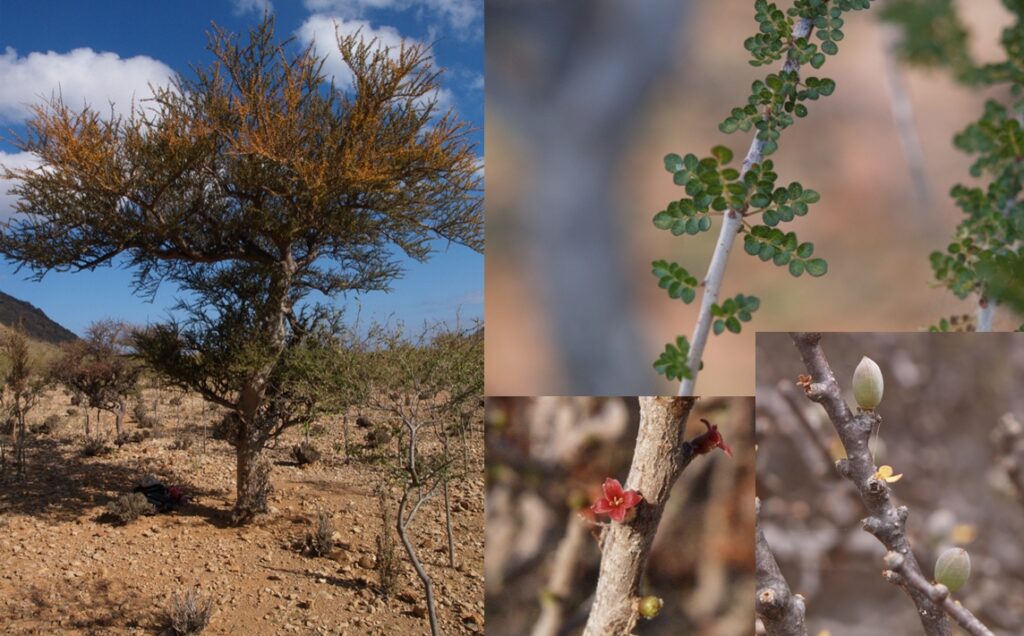
Figure: Commiphora parvifolia (Balf.f.) Engl.
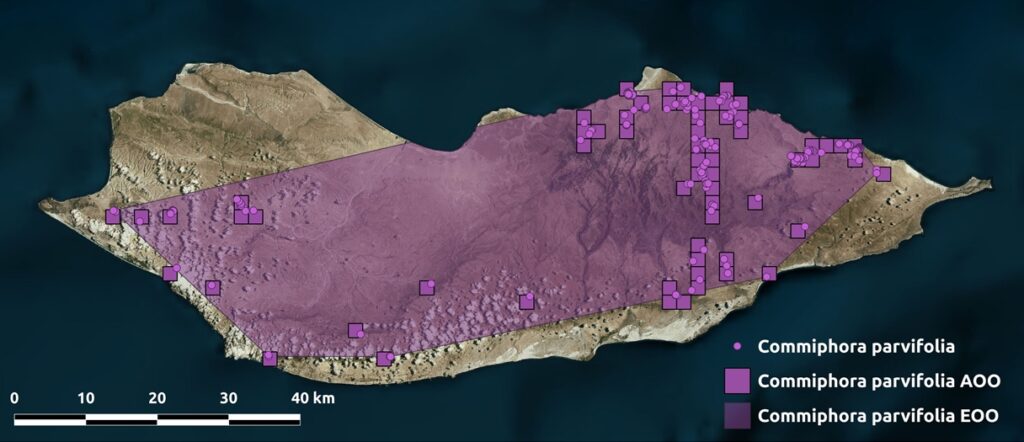
Figure: AOO and EOO of Commiphora parvifolia showing the area of distribution of this endemic species