II.III. Dracaena cinnabari Balf. f.
The dragon blood tree has a unique and strange appearance, with an „upturned, densely packed crown having the shape of an uprightly held umbrella“. It is named after the blood-like color of the red resin that the trees produce. Its leaves arranged in rosettes are found only at the end of its youngest branches; its leaves are all shed every 3 or 4 years as new leaves simultaneously mature. Branching tends to occur when the growth of the terminal bud is stopped, through either flowering. The plants have inflorescences growing from apical bud in the centre of leaf rosette and bear small clusters of fragrant, white, or green flowers. Its fruits are small fleshy berries containing between 1 and 4 seeds. As they develop they turn from green to orange and finally black when ripe.4
Dracaena cinnabari is terciary relict and endemic species to Socotra. In the whole of Socotra, up to the elevational limit of 1100 m a.s.l., a total of 80,134 individual D. cinnabari trees were detected, while using the combination of object-based classification with manual vectorization of remote sensing data. The total area of occupancy was estimated as 519.63 km2. The species is confined to areas subject to the formation of the monsoon mists and clouds, mostly to limestone plateaus and mountains, where the tree profits from its ability to intercept horizontal precipitation. The rocky limestone plateaus are located between 400 and 700 m a.s.l. and the D. cinnabari grows here as an emergent in open semi-evergreen Buxanthus pedicellatus–Dracaena cinnabari woodland. The montane and high-montane vegetation with D. cinnabari is found on limestone foothills and granite peaks above 700 m a.s.l., where the temperature drops during the late afternoon and evening leads to the regular formation of clouds. The interception of horizontal precipitation from clouds and monsoon mist together with dewfall substantially enhance the available moisture leading to the formation of lush vegetation where dragon trees grow as scattered emergents overlooking a dense species-rich shrub layer. The findings indicate that D. cinnabari acts as an ecosystem engineer, i.e., a key species that alters the abiotic environment, controls the availability of resources, and facilitates the growth of other species.
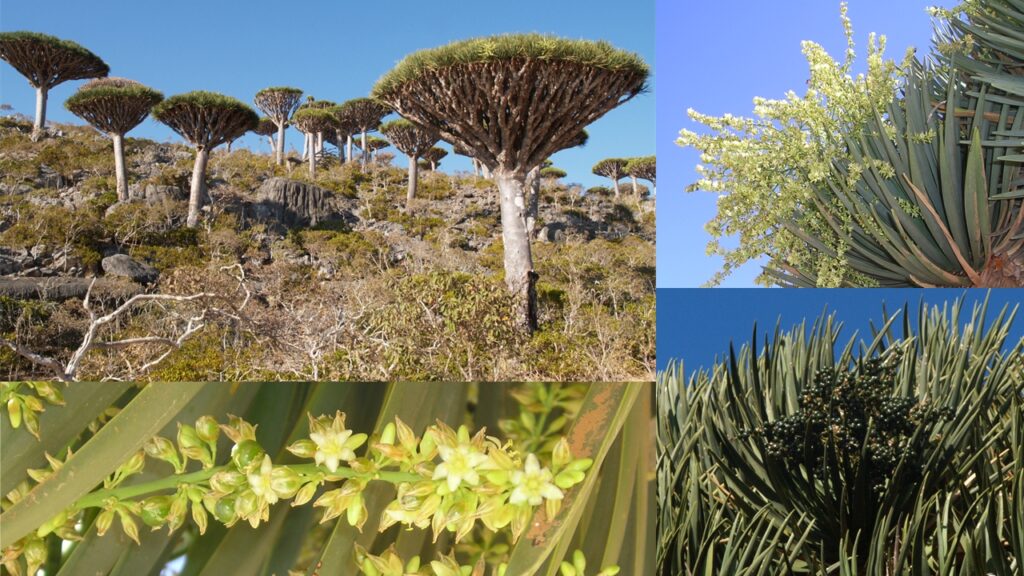
Figure. Dracaena cinnabari Balf. f.
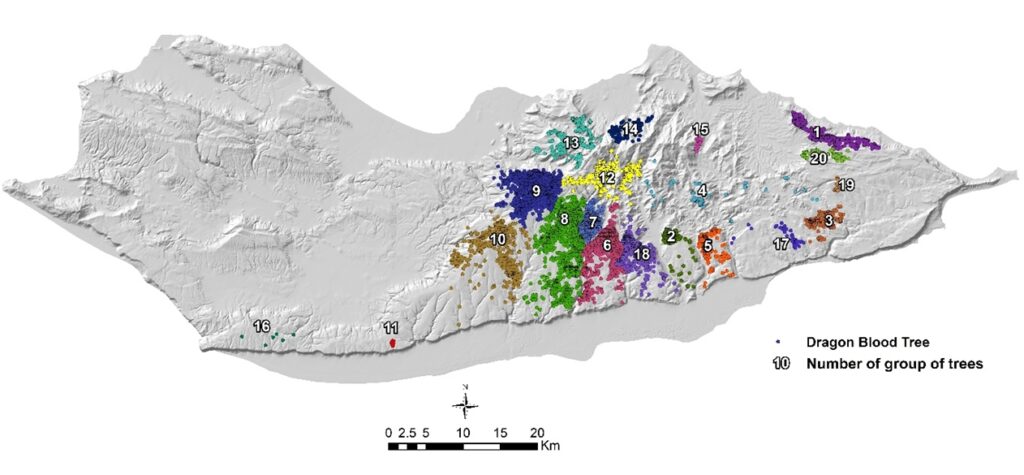
Figure. Distribution of 20 subopulations of Dracaena cinnabari in Socotra Island